The dispensary

Tooth powder

A fluoride-free mineral powder built from a short list of ingredients you could find in a kitchen or a garden — nothing else.

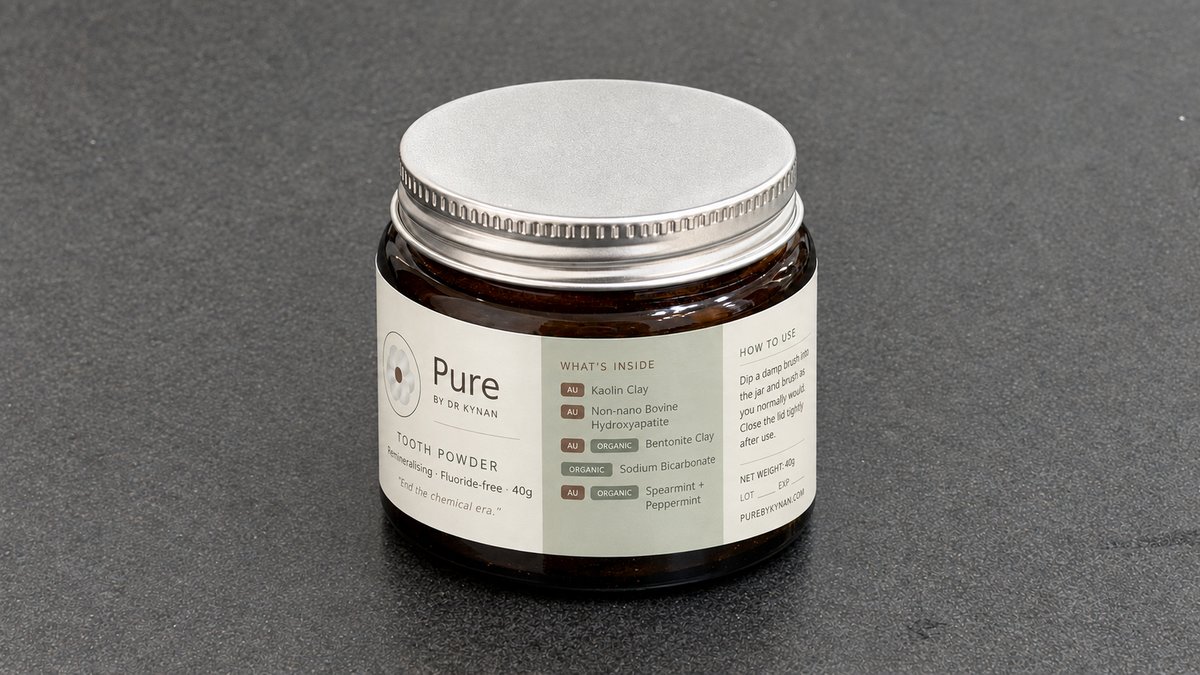
Jar of Pure by Dr Kynan tooth powder
No. 01 · Organic · Handmade in Australia

Mint Tooth Powder

A fluoride-free mineral powder built on kaolin and bentonite clays, boosted with the highest concentration of non-nano bovine hydroxyapatite in any tooth powder in Australia. Cleans and remineralises without a trace of sulfate foam — finished with organic peppermint and spearmint oils. Hand made on the Gold Coast, Australia.

  • AUKaolin Clay
  • AUNon-nano Bovine Hydroxyapatite (~22%)
  • AUOrganicBentonite Clay
  • OrganicSodium Bicarbonate
  • AUOrganicPeppermint Oil
  • AUOrganicSpearmint Oil
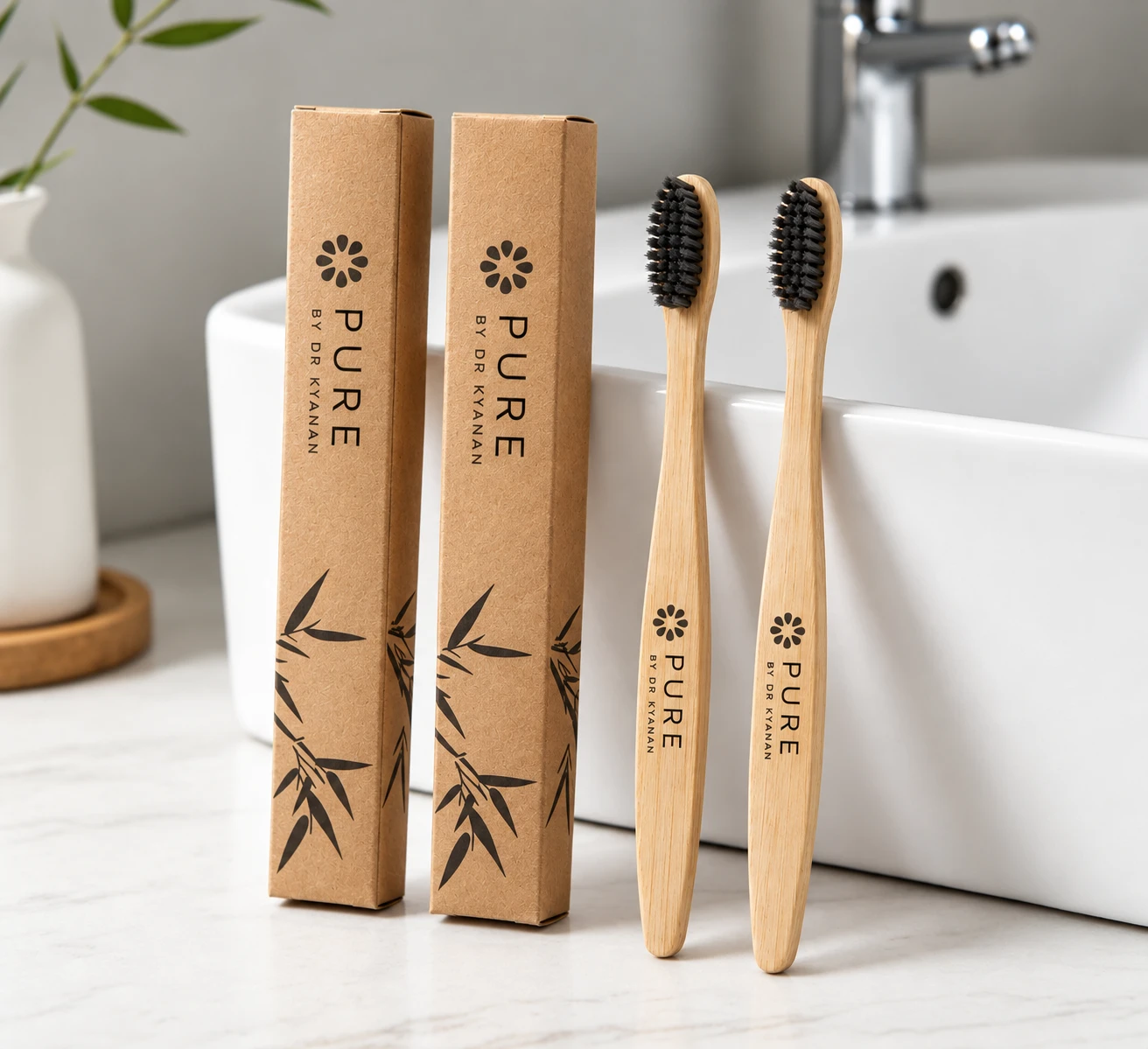
Pure by Dr Kynan bamboo & horse hair toothbrush Free toothbrush! One bamboo & horse hair toothbrush included with every jar — see the toothbrush →

Buy more, save more — 2 jars: 5% off · 3+ jars: 10% off — mix & match either size

25g $8 / jar
1
50g $12 / jar
1

Shipping selected at checkout

Handling: 3 business days · Shipping: 3 business days (Australia Post standard, express available at checkout)

Currently sold out — we're working hard to make more Pure Tooth Powder. New stock is expected to ship from 13 October 2026. You can still order now, but please expect a delay before dispatch. Once shipped, allow 3 business days for handling plus 3 business days for Australia Post standard delivery.

Going fully plastic-free too? Shop our bamboo & horse hair toothbrush →

Our promise

What's never in the jar

Every jar of Pure Tooth Powder is checked against this list before it earns the label.

No parabens No sulfates No synthetic fragrance No artificial dyes No phthalates No microplastics No aluminium

Know what's inside

Every ingredient, explained

No mystery blends or trade-secret fillers — here's exactly what's in the jar, sourced from, and why it's there.

AU

Kaolin Clay

Sourced from pure kaolin ore deposits in Western Australia, formed over millennia as granite slowly weathered into clay. It's 100% natural, free of organic contaminants, and BP/Pharmaceutical grade — the same purity standard used in medicine, not just skincare.

This is the powder's abrasive — the fine particles doing the actual work of lifting plaque and surface stain off your teeth. Kaolin's Mohs hardness is 2–2.5, well below both dentine and enamel, so it can't scratch either even with daily brushing. See how that compares ↓

AU

Non-nano Bovine Hydroxyapatite (~22%)

Hydroxyapatite is the mineral your teeth are already made of. It remineralises enamel and fills the micro-cracks that appear over time — doing what fluoride claims to do, biocompatibly, because your body already recognises it.

Ours is sourced from young, pasture-fed Australian cattle (BSE-free, mRNA-vaccine-free) as naturally-occurring micro-particles — not synthetic nano-hydroxyapatite, the lab-made version increasingly linked to concerns about absorption into the bloodstream. We chose the ingredient that occurs in nature, not the one made in a lab to imitate it.

~22% of the formula — the highest hydroxyapatite concentration of any tooth powder in Australia, well above the 5–15% typical in commercial n-HAp toothpaste.

AU Organic

Bentonite Clay

Formed from volcanic ash trapped in Australian seabeds for millions of years, then finely milled to 45 microns for a texture that's silky rather than gritty. Harvested, dried and packaged with zero chemicals — Food Standards Australia & NZ compliant, vegan, allergen-free, and never tested on animals.

This is the texture ingredient: bentonite swells on contact with water, turning a dry powder into a smooth, spreadable paste as you brush. At a Mohs hardness of just 1–2, it's one of the softest clays used in oral care — softer even than the kaolin it's blended with.

Organic

Sodium Bicarbonate

A premium-grade bicarb harvested from a natural mineral deposit, chosen because it's aluminium-free and an approved input for organic cosmetic manufacturing. No fillers, anti-caking agents, colours or fragrance — non-GMO, allergen-free, and never tested on animals.

It pulls double duty: a second, gentler abrasive alongside the kaolin, and the ingredient doing most of the actual stain-lifting — its mild alkalinity helps break down the surface staining from tea, coffee and red wine that clay alone won't shift. At a Mohs hardness of 2.5, it's still well under enamel and dentine. See how that compares ↓

AU Organic

Peppermint Oil

Certified organic and ethically sourced, with nothing synthetic added to boost the flavour. Plant-based, vegan, and free of GMOs — real peppermint, doing what real peppermint does.

AU Organic

Spearmint Oil

Certified organic and ethically sourced alongside our peppermint, with no synthetic enhancers or GMOs. Plant-based and vegan — a clean, rounded finish rather than an artificial minty burn.

Softer by design

How abrasive is too abrasive?

Mohs hardness measures how easily a mineral scratches — the same scale geologists use for rocks and gemstones. It's also a useful, honest way to think about a tooth powder's abrasive: if it's softer than your enamel and dentine, it physically can't scratch them. If it's harder, it can, however gently that's marketed.

Pure's ingredients For comparison
Bentonite Clay
1–2
Kaolin Clay
2–2.5
Sodium Bicarbonate
~2.5
Dentine
3–4
Enamel
4.5–5
Typical whitening abrasive (hydrated silica)
4.2–7

Mohs hardness scale — 0 is talc-soft, 10 is diamond

Bentonite, kaolin and sodium bicarbonate all sit well below both dentine and enamel — soft enough that none of them can scratch either, even with twice-daily brushing over years. Many mainstream toothpastes lean on hydrated silica for whitening power, a mineral hard enough to sit at or above enamel's own hardness. It's an effective stain-lifter, just not something we think belongs in a tooth powder used every day.

The chemical era

Why we went chemical-free

Most people never read what's actually in their toothpaste. As a doctor, Dr Kynan did — and didn't love what he found. Preservatives designed to survive years on a shelf. Foaming agents added for a mouth-feel, not a clean. Fragrance blends that can legally hide dozens of undisclosed chemicals. None of it dangerous enough to make headlines on its own, but none of it necessary either — and all of it going into the part of your body that absorbs things fastest: your mouth.

What's actually in most products

The ingredients we won't use

None of these are secret or new concerns — they're just not worth the risk when better, natural alternatives already exist.

Fluoride

Added to most toothpaste to help prevent decay, but effective remineralisation doesn't actually require it — hydroxyapatite does the same job using a mineral your teeth already contain. We use that instead, without the long-running debate over ingestion risk, especially in children.

Sulfates (SLS/SLES)

The foaming agent in most toothpaste and soap, added purely for the sudsing sensation, not the clean. It's also a known irritant for sensitive gums and skin. A lack of foam doesn't mean a lack of clean — we left it out entirely.

Parabens

Cheap preservatives used to extend shelf life, absorbed through skin and mucous membranes. The long-term effects are still debated, but there was no reason to take the risk when a simple mineral base doesn't need them to stay stable.

Synthetic fragrance

"Fragrance" on a label can legally hide dozens of undisclosed synthetic chemicals, some linked to skin sensitisation. We use real essential oils instead — you know exactly what you're tasting.

Artificial dyes

Purely cosmetic, added so a product looks a certain colour on a shelf. They do nothing for your teeth and everything for marketing. Left out entirely.

Phthalates

Common plasticisers, often hidden inside undisclosed "fragrance," and studied for possible endocrine effects. We don't use synthetic fragrance in the first place, so there's nothing for them to hide inside.

Microplastics

Tiny plastic beads once common in toothpaste as a mild abrasive — now banned in some countries, still legal in others. Our clays do the same job without leaving plastic in your mouth or the water supply.

Aluminium

More commonly flagged in deodorants, but it shows up in some dental products too, as an anti-caking or whitening agent. We chose a genuinely aluminium-free formula.

The research

What we chose to leave out of our tooth powder, and why

A closer look at specific ingredients common in mainstream toothpaste formulas — what they're for, what the research says, and why we formulated without them.

Ingredient The concern Reference
Sodium Lauryl Sulfate (SLS) Detergent/foaming agent linked to oral mucosa irritation and worsening of recurrent mouth ulcers in sensitive people. PubMed →
Titanium Dioxide Whitening/opacifying agent; regulatory risk assessments couldn't rule out risk to internal organs from the nanoparticle fraction on repeated ingestion. PubMed →
Carrageenan Thickener; several reviews link it to disrupted gut barrier function and intestinal inflammation. PubMed →
Cocamidopropyl Betaine Co-surfactant; a recognised cause of allergic contact dermatitis in a subset of users, though more recent analysis suggests true allergy is less common than once thought. PubMed →
Propylene Glycol Humectant/solvent; a documented, if uncommon, cause of allergic and irritant contact dermatitis. PubMed →
PEG (e.g. PEG-6, PEG-12) Surfactant/humectant; manufacturing can leave trace 1,4-dioxane — classified a probable human carcinogen — as a contaminant. PubMed →
Synthetic colours (e.g. CI 74160, CI 74260, CI 73360) Artificial dyes; the Southampton studies and later reviews link mixes of these to increased hyperactivity in children. PubMed →
Triclosan Antibacterial agent; substantial evidence of endocrine-disrupting activity, part of why most brands have moved away from it. PubMed →

On fluoride, specifically — this one deserves its own note. Recent research, including a 2024 US National Toxicology Program review and a 2025 JAMA Pediatrics meta-analysis, has found associations between high fluoride exposure and lower childhood IQ. But that evidence relates almost entirely to naturally high fluoride levels in drinking water, not standard fluoridated toothpaste used and spat out as directed.

Major dental bodies, including the Australian Dental Association, continue to recommend fluoride toothpaste for cavity prevention, and this remains a genuinely contested, active area of research — not settled proof that toothpaste-level fluoride causes harm. We formulate without it because non-nano hydroxyapatite already does the remineralising job well, and because some people simply prefer to avoid it — not because we consider fluoride toothpaste unsafe. Reference →

From Dr Kynan

A simple rule

After years of patients asking what half the words on a toothpaste tube meant, I started mixing something simpler on a kitchen counter. The rule I stuck to was this: if it can't be explained in one sentence, it doesn't go in the jar. Everything on this page is that rule applied — one ingredient at a time.

"If it can't be explained in one sentence, it doesn't go in the jar."

Before you order

Currently sold out — we're working hard to make more Pure Tooth Powder. New stock is expected to ship from 13 October 2026. You can still order now, but please expect a delay before dispatch. Once shipped, allow 3 business days for handling plus 3 business days for Australia Post standard delivery.

Your cart

Subtotal

Shipping calculated at checkout.